Main result (OLMo-2-1B). Starting from a 4T-token checkpoint, a short SAM mid-training phase preserves more pretraining-benchmark accuracy after post-training (Meta-Math, Tülu-3) and 4-bit quantization.
Abstract
Pretraining optimizers are tuned to produce the strongest possible base model, on the assumption
that a stronger starting point yields a stronger model after subsequent changes like post-training
and quantization. This overlooks the geometry of the base model which controls how much of the base
model's capabilities survive subsequent parameter updates. We study three pretraining optimization
approaches that bias optimization toward flatter minima: Sharpness-Aware Minimization (SAM), large
learning rates, and shortened learning rate annealing periods. Across model sizes ranging from 20M
to 150M parameters, we find that these interventions consistently improve downstream performance
after post-training on five common datasets with up to 80% less forgetting. These principles hold at
scale: a short SAM mid-training phase applied to an existing OLMo-2-1B checkpoint reduces forgetting
by 31% after MetaMath post-training and by 40% after 4-bit quantization.
Pretraining loss isn't the whole story
Pretraining optimizers are tuned to make the strongest base model. But in a multi-stage pipeline we want a model that stays strong after further modification.
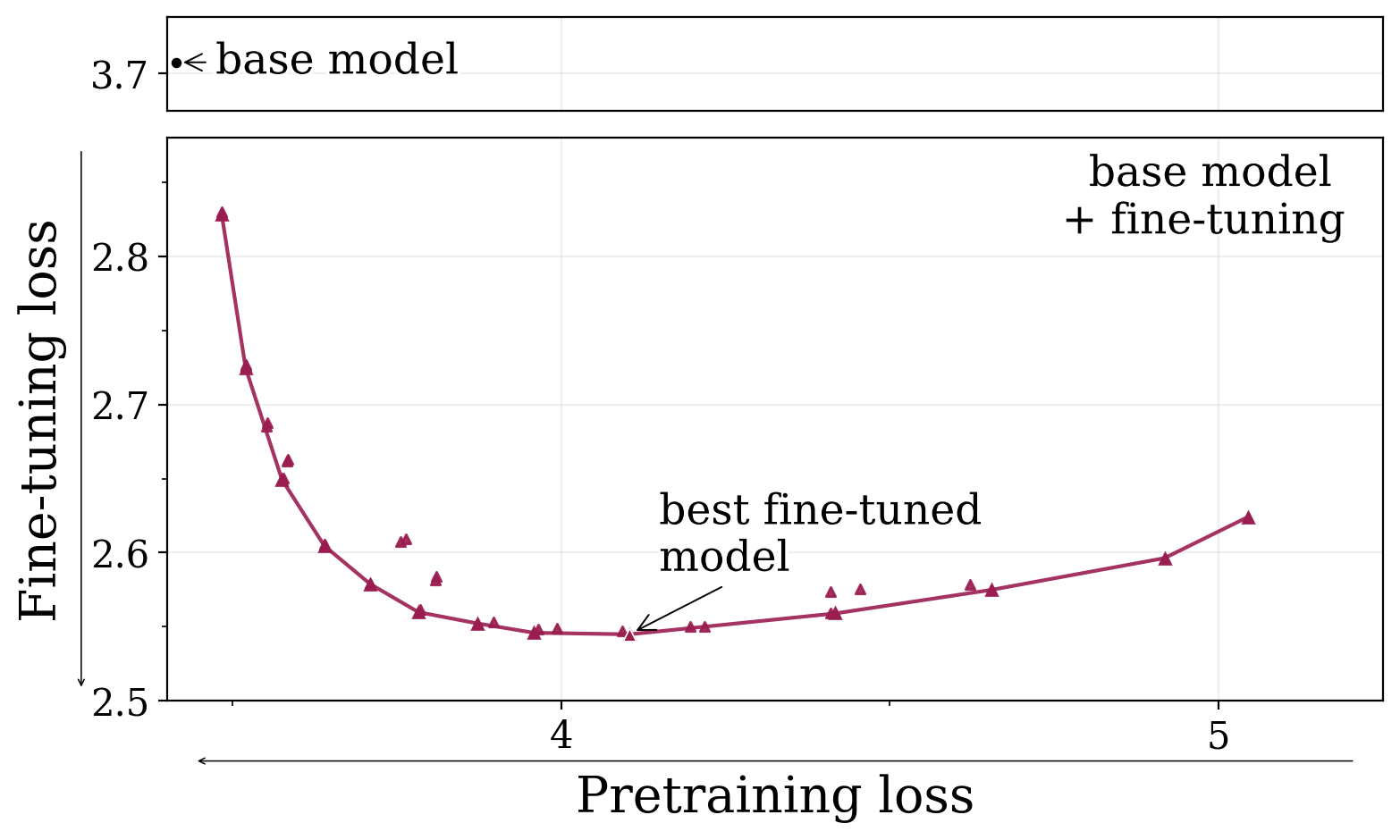
Pretraining loss alone doesn't capture a base model's adaptivity. The hidden variable is forgetting: fine-tuning performance depends on how much of the pretrained knowledge the new task relies on still survives the update. So base models that forget less end up learning more — the right yardstick is the learning–forgetting tradeoff 👇, not base quality.
The learning–forgetting frontier. We pretrain a model from scratch, then fine-tune it under a range of varying hyperparameters to get a Pareto frontier between fine-tuning loss (learning) & pretraining loss (forgetting).
Main Claim: Reducing the sharpness of the pretraining loss improves the learning–forgetting tradeoff.
Changes to the optimizer to reduce sharpness
Explicit: Sharpness-Aware Minimization (SAM)
SAM (Foret et al., 2021) minimizes the worst-case loss in a neighborhood of the weights, steering pretraining into wider, flatter, forgetting-resistant minima.
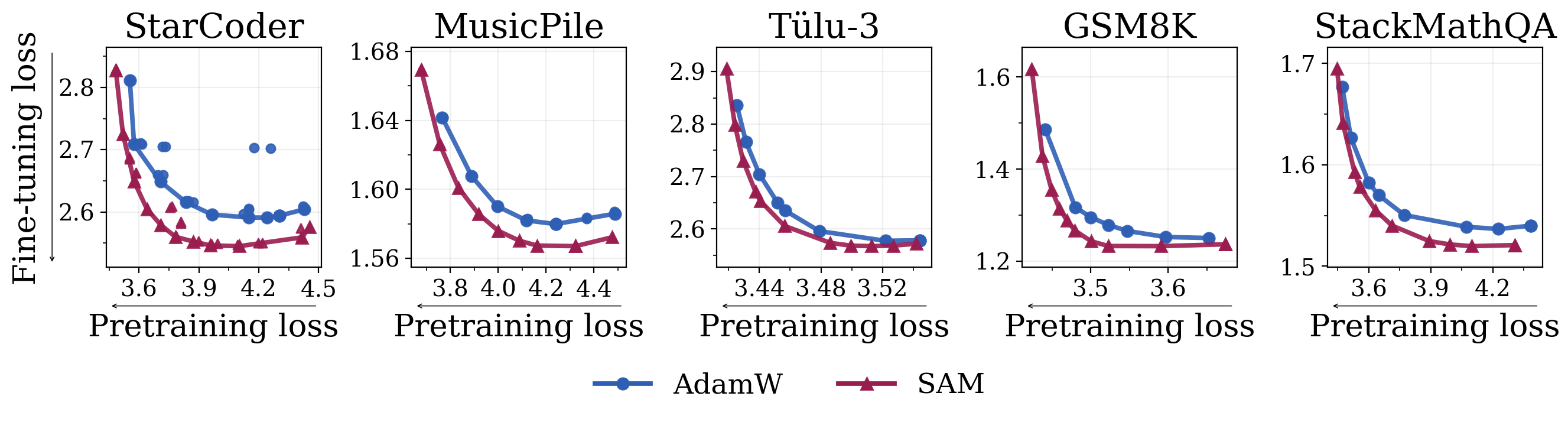
We pretrain OLMo-60M models with a cosine schedule using AdamW and SAM on 192B tokens and
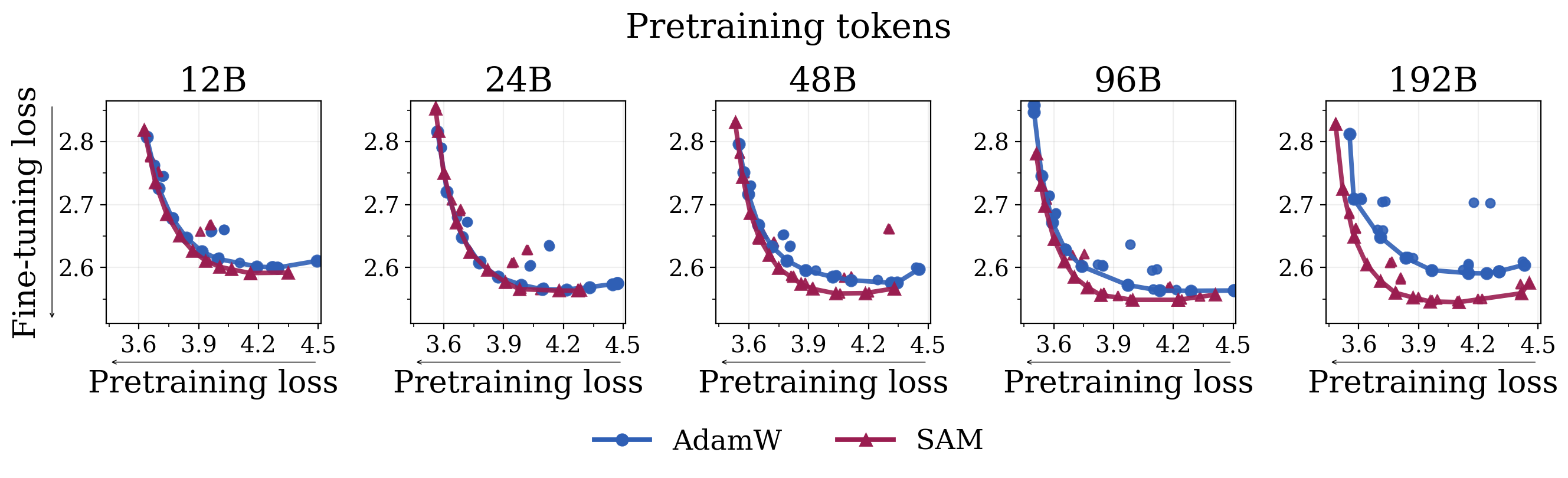
fine-tune on five datasets. SAM achieves a better learning-forgetting frontier.We pretrain OLMo-60M models with a cosine schedule using AdamW and SAM on 4B to 192B tokens and fine-tune on StarCoder. The gap between SAM and AdamW widens as we scale pretraining tokens.
Finding
SAM improves the learning–forgetting tradeoff across datasets, and its advantage over AdamW grows with more pretraining tokens.
Implicit: Peak learning rate
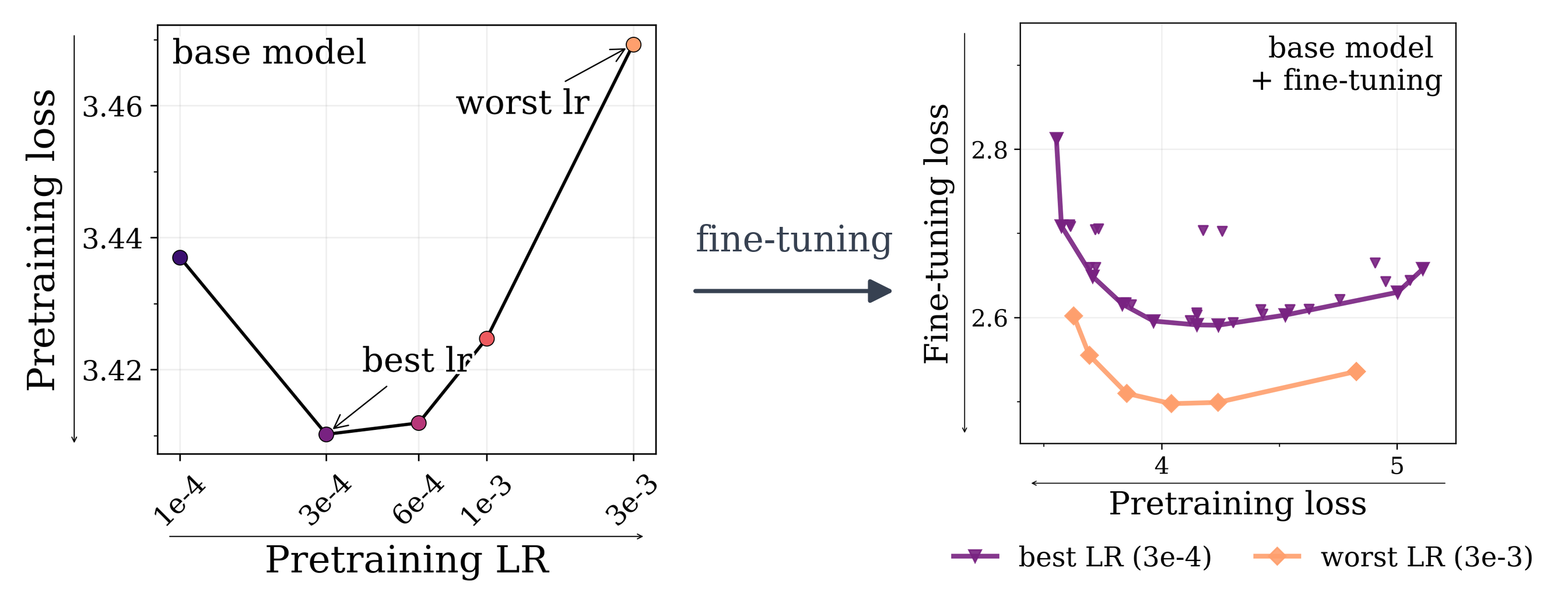
Gradient descent settles at the edge of stability(Cohen et al., 2021), where the largest Hessian eigenvalue (sharpness) is capped at ≈ 2/η by the learning rate η — so a larger peak LR bounds sharpness lower and forces a flatter minimum.
Peak learning rate vs pretraining loss (left), and the resulting learning–forgetting frontier after fine-tuning (right).
Finding
Higher peak LR improves the learning–forgetting tradeoff.
More in the paper
(1) The intuition behind why minimizing sharpness helps, (2) a Hessian analysis of our sharpness approximation, and (3) scaling behaviours across model sizes and token budgets.
BibTeX
@misc{watts2026sharpnessawarepretrainingmitigatescatastrophic,
      title={Sharpness-Aware Pretraining Mitigates Catastrophic Forgetting},
      author={Ishaan Watts and Catherine Li and Sachin Goyal and Jacob Mitchell Springer and Aditi Raghunathan},
      year={2026},
      eprint={2605.02105},
      archivePrefix={arXiv},
      primaryClass={cs.LG},
      url={https://arxiv.org/abs/2605.02105},
}